
Have you ever skipped physiotherapy appointments due to difficulty in travelling to clinics or just being unable to find time?
Are you worried that skipping physiotherapy would affect your recovery?
You are not the only one facing these problems. Regular visits to hospitals and rehabilitation centers can become a physical as well as emotional burden for many people.
Nowadays, the availability of home health care services in India is becoming more common, and home physiotherapy is one of them. For many families, it offers a practical and convenient way to continue recovery.
But many caregivers have questions: Is home physiotherapy effective? What are the benefits of physiotherapy at home?
In this article, we will look at what home-based physiotherapy is and how it can help you heal easily and with less stress.
What Is Physiotherapy at Home and Why It Matters?
Physiotherapy at home allows you to receive physiotherapy treatments from the comfort of your home, without having to go to hospitals or clinics.
A qualified physiotherapist prepares a treatment plan for you based on your condition and helps you recover.
There are several case scenarios in which home physiotherapy would be ideal:
- In the case of musculoskeletal injury
- In the case of sports injuries
- In recovery from surgery
- In arthritis
- In back and neck pain
- In nerve conditions such as stroke or Parkinson’s disease.
Read Also: Benefits of Home Healthcare: Safe, Personalized Care at Your Doorstep
How Home Physiotherapy Works: Step-by-Step Process
Not sure what happens when a physiotherapist comes home for treatment? It’s actually quite straightforward. The therapist first asks about your problem, checks your condition, then starts the treatment step by step — so there’s nothing to worry about.
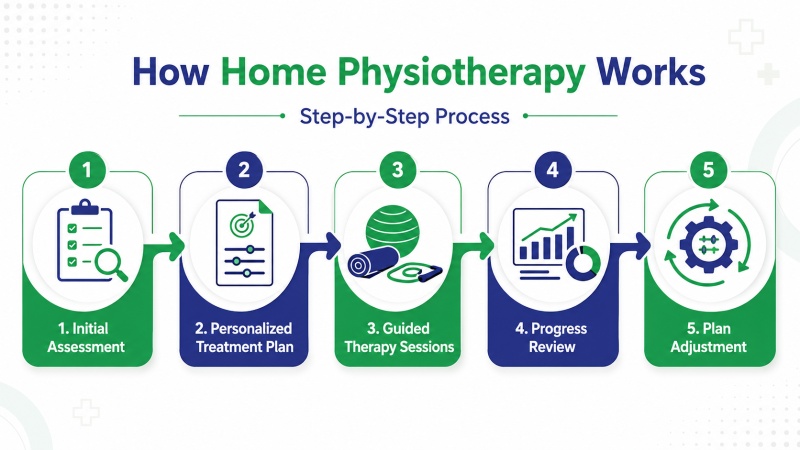
1. Initial Assessment
The physiotherapist comes to your home and checks how you’re doing — your pain, how well you can move, and your strength. They also look around your house, like the stairs, furniture, and open space, so they can plan exercises that actually fit your daily life.
2. Personalized Treatment Plan
After the assessment, we prepare a treatment plan just for you. It is not a standard plan — we look at your age, your medical history, and how much activity you can manage right now, and plan your recovery accordingly.
3. Guided Therapy Sessions
The physiotherapist comes to your home and works with you one-on-one. They help you with exercises and hands-on therapy, and correct your posture or movement right there, on the spot. Since it’s just you and the therapist, you get proper attention throughout the session.
4. Progress Review
Recovery is not a one-time thing — it’s checked regularly. Your therapist keeps an eye on your progress, like how much strength you’re gaining, how the pain is changing, and how well you’re able to move. Based on this, they note down what’s working well for you and what needs to be changed.
5. Plan Adjustment
Your exercise plan changes as you get better. Say you’re recovering from a knee surgery — you’ll start with simple stretches, and slowly move to strength exercises and walking, once your body is ready for it.
This way, your treatment always matches where you are in recovery. It doesn’t stick to one fixed routine that ignores your progress.
Who Should Consider Home Physiotherapy?
If you are unsure whether home physiotherapy suits your situation, here’s a quick checklist to help you decide:
- People recovering from surgery (knee replacement, hip surgery, spine surgery)
- Patients dealing with sports injuries or muscle and joint strains
- Individuals with chronic pain conditions like arthritis, back pain, or neck pain
- Stroke survivors or those recovering from neurological conditions
- People diagnosed with Parkinson’s disease who need regular mobility support
- Elderly patients with limited mobility or fall risk
- Patients who are wheelchair-bound or bedridden
- Anyone who finds it difficult to travel to a clinic regularly due to pain or distance
- Working professionals who struggle to find time for regular clinic visits
- People with weak immunity who need to avoid crowded hospital spaces
If you fall into any of these categories, home physiotherapy can be a practical and effective option worth considering.
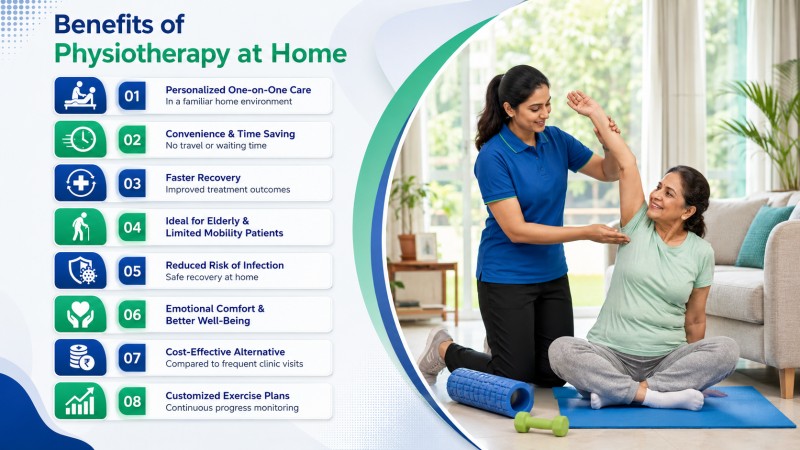
Benefits of Home Physiotherapy:
1. Personalized One-on-One Care in a Familiar Environment:
Each patient’s recovery process is different. In patient-centered physiotherapy, your physical therapist develops a treatment program based on your personal requirements and recovery objectives.
These include:
- Evaluates your health, pain, strength and mobility before starting any treatment program
- Gives you personal attention during all the sessions
- Notices your difficulties and helps you solve them
- Makes your everyday tasks easier for you
- Encourages you to keep on exercising
For example:
- In the case of knee replacement surgery, rehabilitation helps restore movement and independent walking.
- If someone suffers from a frozen shoulder, the exercise focuses on restoring mobility.
2. Convenience and Time-Saving for Patients and Families:
Managing physiotherapy can be tough when you are balancing work and family responsibilities. It helps you save time by providing professional care at your doorstep through doorstep physiotherapy and preventing challenges you may experience when travelling to hospitals and clinics.
All the above-mentioned advantages of home physiotherapy are especially convenient for working professionals and people who are living in crowded cities. These sessions also reduce the load on the caregiver, since they do not need to organize transportation and take patients for therapy sessions. This makes therapy more convenient for both patients and caregivers.
3. Faster Recovery and Better Treatment Outcomes:
Recovering at home means that your therapy can concentrate on the tasks you perform in your daily life. Your physiotherapist can use the stairs, chairs, beds, and other furniture in your home to make the exercises more useful and suitable for you. The exercises are modified to your level of strength and mobility to support fast recovery.
One of the biggest benefits of home‑based rehabilitation is that it is often easier to attend sessions regularly. This consistency matters because good treatment outcomes depend on following your rehabilitation plan step by step.
According to a review published in the journal Disability and Rehabilitation, patients are more likely to continue their home rehabilitation when they feel motivated, confident about doing their exercises, and supported by their family.
4. Ideal for Elderly Patients and Those with Limited Mobility
Older patients and those who have restricted mobility find certain difficulties in coming to their physiotherapy sessions.
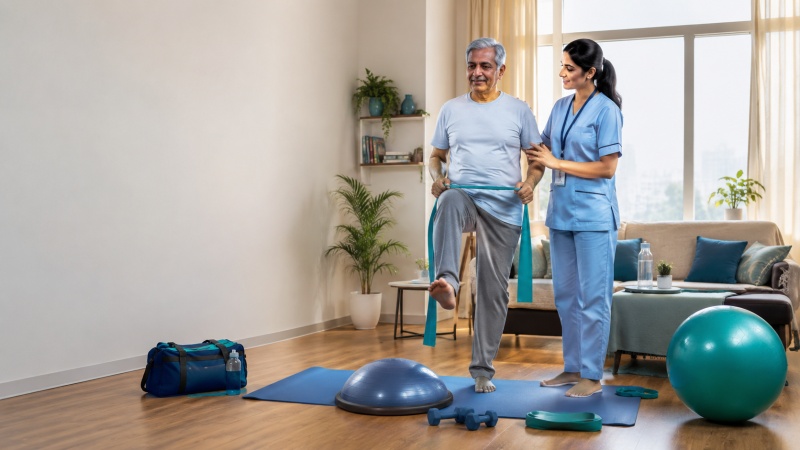
At Icosano, we provide professional physiotherapists at home for people who have been through a traumatic experience such as a stroke or hip fracture, diagnosed with Parkinson’s disease or arthritis, and those who are dependent on a wheelchair for mobility.
They assess your mobility in your own surroundings, recommend safer ways to perform daily activities, identify fall risks, and guide caregivers on supporting your recovery with confidence.
5. Reduced Risk of Infection and Exposure:
Regular visits to clinics can expose you to diseases that are highly contagious, especially those that arise during certain seasons. But with physiotherapy facilities available in your immediate surroundings, not only are you safeguarded against infections, but they even enable you to continue with your rehabilitation process without any disruptions.
This is particularly helpful for the old-aged people, weak immune individuals, and patients who have undergone surgery recently.
6. Emotional Comfort and Mental Well-Being During Recovery:
Home physiotherapy may help your emotional health in many ways:
- You are likely to feel less anxious because of the relaxation you feel in a known environment.
- You get more confident while doing your exercises in your daily living environment.
- You have your family around to motivate you
- You do not have to suffer from stress due to constant hospital visits.
7. Cost-Effective Alternative to Hospital or Clinic Visits:
Many people think home physiotherapy costs more, but it can often help reduce several day-to-day treatment-related expenses.
- Save on travel expenses, including fuel, taxi fares, or public transport.
- Avoid extra costs such as parking fees and frequent commuting.
- Choose from flexible payment plans offered by many home physiotherapy providers.
- Support a smoother recovery, which may reduce the need for prolonged hospital stays and lower overall healthcare expenses.
8. Customized Exercise Plans and Continuous Progress Monitoring:
Recovery does not stop after a few therapy sessions. As your strength and mobility improve, your exercises should also change to match your progress. For example, after a knee replacement, you may begin with gentle stretching and later progress to strengthening and walking exercises.
An observational study published in the Journal of Physical Therapy Science found that people with knee osteoarthritis who received home-based physiotherapy experienced a 52% reduction in pain and a 43% improvement in disability. This highlights how tailored exercise programmes, regular monitoring, and timely adjustments can contribute to better recovery outcomes.
Common Myths About Home Physiotherapy:
There are a few misconceptions that often stop people from choosing home physiotherapy. Let’s clear them up.
Myth: Home physiotherapy costs more than clinic visits
Fact: You spend money on travel, fuel, and parking just to reach the clinic. Add the time you lose in traffic, and it adds up fast. Home physiotherapy can actually save you all this. Plus, many providers let you pay in easy installments, so it’s lighter on your pocket too.
Myth: Therapists can’t provide proper treatment without clinic equipment
Fact: Physiotherapists usually carry some portable equipment when they come for home sessions. But they also use things you already have at home, like your chair, your bed, or even your stairs. This way, the exercises match your real daily routine. And honestly, that’s why home therapy often works better than clinic sessions — it feels more natural and easy to follow at home.
Myth: Home physiotherapy is only for elderly or bedridden patients
Fact: People often think home physiotherapy is only for elderly patients. But that’s not true. It’s just as useful for sports injuries, post-surgery recovery, chronic pain, and even neurological conditions. It works for all age groups.
Myth: Recovery is slower at home compared to a clinic
Fact: Recovery speed actually depends on how consistent you are, and how well the treatment fits into your daily routine. It has less to do with where you get treated. Home physiotherapy has one big advantage — it happens in your real living space. So the exercises feel more connected to your actual daily tasks. This makes it easier to recover faster and in a way that lasts longer.
Myth: You need a doctor’s referral to start home physiotherapy
Fact: It’s always good to get your doctor’s advice, especially after surgery. But if you want, you can also directly contact home physiotherapy providers like Icosano. They will first check your condition properly before starting any treatment.
Final Thoughts: Recover with Confidence Through Icosano in Kolkata
Recovering from an injury, surgery, or a long-term condition is a journey that requires patience, consistency, and the right guidance. Home physiotherapy makes this process more accessible by bringing expert care to your doorstep, helping you stay committed to your rehabilitation in a familiar environment.
If you are looking for home physiotherapy, Icosano offers personalised treatment plans tailored to your needs and recovery goals. With experienced physiotherapists, patient-centered care, and ongoing support, We helps you regain strength, mobility, and confidence so you can return to your everyday activities with greater independence and comfort.
Start your recovery journey today — Get in touch with Icosano’s physiotherapy team
FAQs:
Home physiotherapy allows a qualified physiotherapist to visit your house and provide treatment based on your specific condition. You receive personalised physiotherapy care without stepping out of your comfort zone, making recovery much easier.
Physiotherapists carry portable equipment suited for home use — resistance bands, mobility aids, and assessment tools — while also using your existing furniture like chairs, beds, and stairs to design practical, real-world exercises.
Home physiotherapy services are especially helpful for elderly patients, post-surgery patients, stroke survivors, and people with arthritis or Parkinson’s disease. Anyone with limited mobility or difficulty travelling to clinics can benefit greatly.
Yes, physiotherapy for elderly patients at home is very safe and recommended. The physiotherapist assesses fall risks, recommends safer ways to perform daily tasks, and guides family caregivers to support safe rehabilitation at home.
Yes, one major advantage of home physiotherapy is avoiding crowded clinics and hospitals where infections can spread easily. This is especially important for elderly patients, post-operative patients, and people with weak immunity who need safe physiotherapy.
A typical home physiotherapy session lasts between 30 to 60 minutes, depending on the condition being treated and the stage of recovery, with frequency adjusted as your therapist monitors your progress.
Home physiotherapy can treat musculoskeletal injuries, sports injuries, post-surgical recovery, arthritis, back and neck pain, and neurological conditions like stroke or Parkinson’s disease.